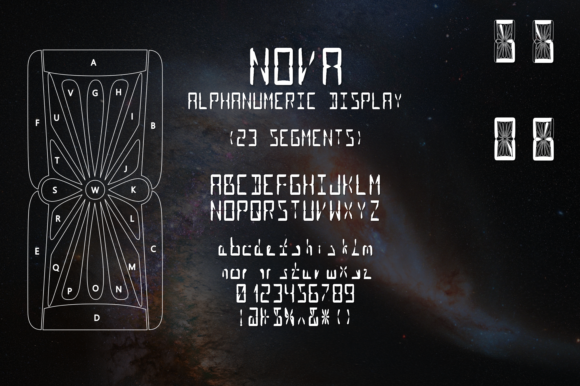
Nova Alphanumeric: A Versatile Choice for Digital Typography
Nova Alphanumeric is a digital font family designed to offer clarity, readability, and versatility across a range of applications. It builds upon the traditional alphanumeric display, which has long been used in technical, industrial, and digital environments. What sets Nova Alphanumeric apart is its inclusion of three distinct denser versions of the standard alphanumeric style. These variations allow designers and developers to tailor their typography to specific needs, whether for high-contrast signage, data visualization, or user interface design.
Understanding the Unique Features of Nova Alphanumeric
The core of Nova Alphanumeric lies in its enhanced density options. Traditional alphanumeric fonts often prioritize legibility at smaller sizes, but they may lack the visual weight needed for certain contexts. Nova Alphanumeric addresses this by offering three levels of density—light, medium, and heavy. Each version maintains the same fundamental structure but adjusts the thickness of strokes and spacing to suit different use cases.
This feature makes Nova Alphanumeric particularly useful in environments where visual hierarchy and contrast are essential. For example, in a control panel or dashboard, a heavier density might be preferred to ensure that numbers and letters remain clearly visible from a distance. In contrast, a lighter density could be more appropriate for a mobile app interface where space is limited and subtlety is key.
The font also retains the clean, geometric lines typical of alphanumeric typefaces, making it compatible with a wide range of design aesthetics. Whether used in a minimalist layout or a complex information architecture, Nova Alphanumeric provides a consistent and professional look.
Comparing Nova Alphanumeric to Similar Options
When evaluating digital typography solutions, it's important to consider how Nova Alphanumeric stacks up against other similar fonts. Many alphanumeric typefaces focus on one primary density, which can limit their adaptability. Nova Alphanumeric’s three-density approach offers greater flexibility, allowing users to select the most suitable variant without switching fonts entirely.
For instance, a designer working on a project that requires both a compact interface and a large-scale display might find Nova Alphanumeric more efficient than using separate fonts for each scenario. This can streamline the design process and maintain visual consistency across different platforms and mediums.
However, it’s worth noting that not all projects require multiple density options. In cases where simplicity and uniformity are prioritized, a single-density alphanumeric font may be sufficient. The decision ultimately depends on the specific needs of the project and the intended audience.
Strengths and Tradeoffs of Nova Alphanumeric
Nova Alphanumeric excels in scenarios where clarity and adaptability are crucial. Its dense variations provide a strong visual presence, making it ideal for environments where readability under challenging conditions is necessary. This includes public signage, digital kiosks, and technical documentation.
Another advantage is its compatibility with modern design tools and platforms. Most graphic design software and web development frameworks support the font format, ensuring that it can be integrated smoothly into existing workflows. This ease of use is a significant benefit for professionals who need reliable and versatile typography solutions.
On the other hand, the increased complexity of having three density options may introduce some challenges. Users must carefully consider which variant best suits their needs, as selecting the wrong one could lead to inconsistencies or reduced legibility. Additionally, while the font is highly readable, it may not be the best choice for projects that require a more stylized or decorative typeface.
Best Fit Situations for Nova Alphanumeric
Nova Alphanumeric is particularly well-suited for projects that involve data-heavy interfaces, such as financial dashboards, scientific reports, or industrial control systems. In these contexts, the ability to adjust density ensures that information remains accessible and easy to interpret, even when displayed in complex layouts.
It is also a strong option for designers working on cross-platform projects. Whether developing a website, mobile application, or print material, the font’s adaptability allows it to perform consistently across different mediums. This can help maintain a cohesive visual identity while meeting the unique demands of each platform.
In addition, Nova Alphanumeric is a practical choice for businesses that need to communicate information clearly and efficiently. For example, a retail company might use the font in its point-of-sale systems to ensure that product codes, pricing, and inventory data are easily readable by staff and customers alike.
When Other Options Might Be Better
While Nova Alphanumeric offers many benefits, there are situations where alternative fonts may be more appropriate. For instance, if a project requires a more artistic or expressive typeface, a custom or decorative font might be a better fit. These alternatives can add visual interest and personality, which may be desirable in branding or editorial design.
Similarly, in cases where minimalism is the goal, a simpler alphanumeric font could be preferable. Some designers may find that the additional density options in Nova Alphanumeric introduce unnecessary complexity, especially when working on clean, uncluttered designs. In such instances, sticking to a single-density font could help maintain a more streamlined aesthetic.
It’s also important to consider the target audience. If the primary users of a design are not familiar with alphanumeric typography, a more intuitive or widely recognized font might be more effective. Accessibility and user experience should always be a priority, and sometimes a more conventional typeface can be just as functional—or even more so—than a specialized one like Nova Alphanumeric.
Realistic Examples of Use Cases
One common use case for Nova Alphanumeric is in the design of user interfaces for smart devices. For example, a fitness tracker might use the font in its display to show workout metrics, heart rate, and other data. The heavier density option ensures that the information remains visible even in bright sunlight, while the lighter version could be used in a companion app for a more subtle appearance.
Another example is in the field of education. A learning management system might incorporate Nova Alphanumeric to present course materials, grades, and assignments. The font’s clear and structured design helps students navigate the platform with ease, reducing cognitive load and improving overall usability.
Industrial settings, such as manufacturing plants or warehouses, can also benefit from the font’s adaptability. Equipment labels, safety signs, and control panels often require high-contrast typography to ensure that critical information is understood quickly. Nova Alphanumeric’s three-density options make it a practical choice for these environments, where accuracy and efficiency are paramount.
Making an Informed Decision
Choosing the right alphanumeric font involves considering several factors, including the intended use, audience, and design requirements. Nova Alphanumeric offers a compelling solution for those who need a flexible and adaptable typeface, but it may not be the best fit for every project.
Before committing to Nova Alphanumeric, it’s advisable to test the font in different contexts to see how it performs. Experimenting with the three density options can help identify which variation works best for specific tasks. Additionally, consulting with other designers or stakeholders can provide valuable insights into the font’s suitability for a given project.
Ultimately, the decision should be based on a balance between functionality, aesthetics, and user needs. By carefully evaluating the strengths and limitations of Nova Alphanumeric, designers and developers can make a more informed choice that aligns with their goals and objectives.