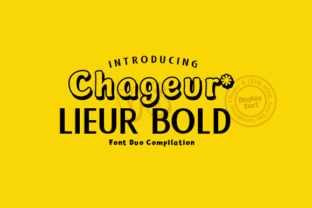
Chageur Lieur Bold Duo: A Strategic Typographic Pair for Clarity, Contrast, and Consistent Tone
Typography isn’t decoration—it’s a decision point. Every font choice signals intent, shapes perception, and quietly influences how seriously your message is taken. Chageur Lieur Bold Duo stands apart not because it’s flashy or novel, but because it offers a rare balance: two distinct yet harmonized typefaces—one relaxed, one serious—that work together without compromise. It’s not a “design trend.” It’s a functional pairing built for people who need to communicate with both warmth and authority, often in the same document, brand, or interface.
What Makes Chageur Lieur Bold Duo Strategically Useful
Chageur Lieur Bold Duo consists of two complementary weights and moods within the same family: one leans into openness and approachability; the other grounds the composition with structure and presence. Neither dominates. Neither apologizes. Together, they form a reliable typographic foundation—especially when consistency matters more than ornamentation.
This duality supports real-world goals. For example, an educator designing course materials might use the relaxed variant for explanatory paragraphs and the bold variant for learning objectives and key takeaways—guiding attention without visual noise. A small business owner drafting a client proposal could apply the softer weight to narrative sections (background, process, values) and the bolder weight to deliverables, timelines, and pricing—making commitments feel tangible and trustworthy.
Where Intentional Use Delivers Measurable Value
Chageur Lieur Bold Duo excels where tone alignment directly affects outcomes:
- Branding & Positioning: When your audience needs to sense both competence and empathy—think financial advisors, healthcare providers, or sustainability-focused startups—the pairing avoids cold formality or unstructured friendliness. It helps position you as capable *and* human.
- Customer Experience: In digital interfaces or printed collateral, using Chageur Lieur Bold Duo consistently across touchpoints (email headers, dashboard labels, onboarding screens) builds subconscious recognition. Users don’t notice the fonts—but they do register coherence, which reduces cognitive load and increases trust.
- Content Strategy: Bloggers and educators benefit from its inherent hierarchy. You don’t need multiple font families to distinguish body text from callouts—you get that clarity from one cohesive system. That simplifies design decisions, speeds up production, and maintains editorial voice across formats.
- Operational Clarity: Internal documents—project briefs, SOPs, training decks—gain precision when headings, instructions, and notes each occupy their own tonal space. The relaxed weight invites reading; the bold weight commands action. That subtle nudge improves follow-through.
How to Approach It—Not Just Apply It
Start by asking: What impression must this piece leave *before* the first sentence is read? If the answer includes words like “thoughtful,” “grounded,” or “accessible but professional,” Chageur Lieur Bold Duo is worth testing—not as a default, but as a deliberate match.
Here’s how experienced designers and communicators integrate it:
- Define the role of each weight upfront. Don’t swap them based on what “looks good.” Assign the relaxed variant to descriptive, reflective, or narrative content—and the bold variant to directives, summaries, or structural anchors. Document that logic in your style guide.
- Test at real sizes and contexts. Its strength lies in readability at 14–18px for body copy and 24–36px for headings—not just in mockups. Print a sample page. View it on mobile. See where contrast holds and where it blurs.
- Reserve variation for meaning—not aesthetics. Avoid using the bold weight for emphasis within paragraphs. Reserve it for elements that carry structural or functional weight (e.g., section titles, CTA buttons, policy headers). Let the relaxed weight carry the flow.
- Pair with neutral supporting fonts—sparingly. Chageur Lieur Bold Duo doesn’t require companions. If you introduce a third typeface (e.g., for data tables or code snippets), choose one with low personality—geometric sans-serifs or monospaced fonts work best. Never let another font compete for tonal attention.
Risks of Using Chageur Lieur Bold Duo Without Context
Like any strong tool, it can misfire when applied without purpose. The most common pitfalls aren’t technical—they’re strategic:
- Tone drift: Using the relaxed weight for legal disclaimers or the bold weight for empathetic support messages undermines credibility. Each weight carries psychological weight—ignore that, and your communication feels unintentional, even if it looks polished.
- Inconsistent application: Switching between weights arbitrarily (e.g., bold for some subheads, relaxed for others in the same document) fractures hierarchy. Readers lose footing. What was meant to clarify becomes confusing.
- Overreliance on appearance over substance: Choosing Chageur Lieur Bold Duo won’t fix vague messaging, poor information architecture, or weak value propositions. It amplifies clarity—it doesn’t create it. Use it to elevate strong content, not mask weak thinking.
- Neglecting accessibility: While both weights are legible, ensure sufficient color contrast (at least 4.5:1 against background) and avoid relying solely on weight to convey meaning for users relying on screen readers.
Long-Term Value Lies in Discipline, Not Design
The real ROI of Chageur Lieur Bold Duo emerges over time—not in a single landing page, but across years of consistent communication. Teams that adopt it thoughtfully report fewer revision cycles, faster stakeholder alignment, and stronger cross-channel recognition. Why? Because it removes subjective debates (“Should this be bold or light?”) and replaces them with clear, documented rules.
Consider this: A freelance designer working with five different clients might use Chageur Lieur Bold Duo only for those whose positioning hinges on balanced authority and approachability—say, a career coach or a boutique HR consultancy. For a tech startup emphasizing speed and disruption, it may be too measured. That selectivity isn’t limitation—it’s strategic focus.
Similarly, educators building modular curriculum assets find long-term efficiency in locking Chageur Lieur Bold Duo into their template library. Once defined, it scales: new lessons, updated slides, revised handouts all inherit the same tonal framework. That consistency saves hours per project—and reinforces pedagogical intent.
Practical Planning Tips for Immediate Use
- Start small. Don’t overhaul everything. Pick one recurring asset—a monthly newsletter, a service page, or internal meeting agenda—and apply Chageur Lieur Bold Duo there for 30 days. Note how readers respond, where confusion lingers, and where clarity improves.
- Map weight usage to content function. Create a simple table: “Relaxed = explanations, stories, context. Bold = actions, deadlines, definitions, decisions.” Keep it visible during writing and design sessions.
- Review before publishing—not after. Before sending, ask: Does every bold-weight element serve a structural or functional purpose? Does every relaxed-weight block invite understanding rather than dilute urgency?
- Train, don’t assume. If others contribute to your content (team members, contractors, clients), share your rationale—not just the fonts. A 5-minute explanation of *why* each weight exists prevents accidental misuse.
Chageur Lieur Bold Duo doesn’t promise transformation. It offers something more valuable: reliability. In a landscape crowded with fleeting trends and performative aesthetics, it supports work that endures—not because it shouts, but because it listens, balances, and holds space for both gravity and grace. Use it when your goals demand neither rigidity nor looseness alone—but both, in service of something clearer, calmer, and more consequential.