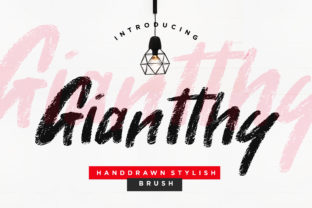
Giantthy: A Handwritten Brush Font for Personalized Design
Giantthy is a unique handwritten brush font that offers a personal and artistic touch to any design project. Its fluid, expressive strokes make it ideal for creating a sense of authenticity and creativity in visual work. Whether you're designing a logo, crafting social media graphics, or developing branding materials, Giantthy can add a distinctive flair that stands out from more rigid typefaces.
What Makes Giantthy Unique?
Giantthy is designed to mimic the natural flow of a brush stroke, giving it an organic and handcrafted feel. Unlike standard fonts that are often uniform and mechanical, Giantthy introduces variation and movement that can enhance the emotional impact of text. This makes it particularly appealing for projects that aim to convey warmth, creativity, or individuality.
The font features a range of letterforms that vary slightly in weight and shape, which can be beneficial for designers looking to create a more dynamic composition. Its versatility allows it to work well in both digital and print formats, making it a flexible choice for various applications.
Why Someone Might Choose Giantthy
Designers and creatives who prioritize a personalized appearance may find Giantthy to be an attractive option. It is especially useful when the goal is to evoke a sense of intimacy or human touch, such as in invitations, greeting cards, or branding for small businesses that want to stand out from the competition.
For those working on projects with a focus on artistry or storytelling, Giantthy can help reinforce the narrative by adding a visual element that feels more authentic. It also works well for brands that want to communicate a sense of craftsmanship or individuality through their typography.
Benefits of Using Giantthy
One of the main advantages of Giantthy is its ability to add a unique character to any design. This can be especially valuable when working on projects where differentiation is key. The font’s natural variation helps avoid the monotony often associated with standard typefaces, allowing for more engaging and visually interesting compositions.
Additionally, Giantthy is easy to use across different platforms and design software. Most modern design tools support custom fonts, so integrating Giantthy into a workflow should be straightforward. Its readability is generally good, though it may require careful spacing and sizing to ensure clarity, especially in longer texts.
Considerations and Tradeoffs
While Giantthy offers a distinct aesthetic, it may not be suitable for every design scenario. For instance, in situations where clarity and legibility are paramount—such as in signage, large-scale printing, or technical documents—Giantthy might not be the best choice. Its stylized nature could compromise readability, particularly at smaller sizes or in dense layouts.
Another consideration is the context in which the font will be used. If the design requires a more formal or professional tone, Giantthy may not align with the desired aesthetic. In such cases, alternative fonts that offer a cleaner, more structured appearance might be more appropriate.
Situations Where Giantthy Excels
Giantthy is particularly well-suited for creative projects that benefit from a personal touch. This includes branding for independent artists, boutique businesses, or events that emphasize individuality. It can also be effective in marketing materials that aim to connect emotionally with the audience, such as campaigns for handmade products, artisanal services, or community-based initiatives.
When paired with other design elements like illustrations, watercolor textures, or bold colors, Giantthy can create a cohesive and expressive visual identity. It works especially well in designs that aim to feel approachable, friendly, or nostalgic.
When Alternatives May Be Better
For projects that require a more polished or standardized look, alternatives to Giantthy may be preferable. Fonts like Helvetica, Arial, or Futura offer clean lines and consistent spacing, making them ideal for corporate branding, editorial design, or user interfaces where clarity is essential.
Additionally, if the design needs to maintain a high level of professionalism, a serif font such as Georgia or Times New Roman might be more appropriate. These fonts provide a traditional and trustworthy appearance that can complement certain types of content or industries.
Practical Decision-Making Insights
When deciding whether to use Giantthy, consider the purpose of the design and the message it aims to convey. If the goal is to express creativity, individuality, or a handmade quality, Giantthy can be a strong fit. However, if the design requires a more structured or formal appearance, it may be necessary to explore other options.
It’s also helpful to test the font in different contexts before finalizing a design. Experimenting with size, color, and surrounding elements can reveal how well Giantthy performs in specific scenarios. This process can help identify potential challenges and ensure that the font enhances, rather than hinders, the overall design.
Ultimately, the decision to use Giantthy should be based on its alignment with the project’s goals and the expectations of the target audience. By carefully evaluating these factors, designers can determine whether Giantthy is the right choice for their needs.