Happy Xmas: A Thoughtful Font for Modern Creativity
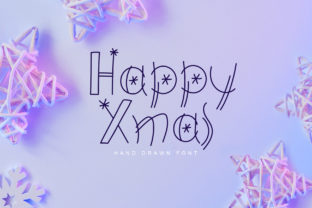
Happy Xmas isn’t just a seasonal novelty—it’s a quietly confident typeface designed for clarity, charm, and quiet intention. At first glance, its soft curves and balanced proportions suggest warmth and approachability. But look closer: the delicate snowflakes dotting its punctuation, floating beside letters like gentle reminders of stillness and craft. These aren’t decorative afterthoughts. They’re integrated thoughtfully—appearing as alternate glyphs, accessible via OpenType features—and they reinforce what makes Happy Xmas distinctive: it bridges playfulness with precision.
Why This Font Resonates Now
Over the past five years, design preferences have shifted toward authenticity over polish. Consumers and creators alike are less drawn to hyper-slick, algorithm-optimized visuals and more responsive to work that feels handmade, considered, or gently imperfect. That’s where Happy Xmas fits—not as a throwaway holiday font, but as part of a broader movement toward intentional typography. Its snowflakes echo the rise of tactile digital experiences: think hand-drawn UI elements in SaaS dashboards, illustrated icons in educational tools, or custom lettering in boutique brand identities. It’s not about nostalgia; it’s about signaling care through detail.
This aligns with how professionals actually work today. Designers, marketers, and educators often juggle multiple platforms—Canva for quick social assets, Figma for collaborative wireframes, Adobe apps for print-ready layouts. Happy Xmas performs well across them all: its clean baseline ensures readability at small sizes (ideal for email headers or app notifications), while its expressive alternates add personality where space and context allow (think Instagram story text overlays or printable workshop handouts).
Scandinavian Style, Reimagined for Everyday Use
When people describe Happy Xmas as “Scandinavian,” they’re responding to its restraint—not austerity, but thoughtful economy. There’s no excess weight, no forced contrast, no visual noise. The snowflakes follow that same principle: minimal in form, maximal in resonance. Each one is geometrically simple—a six-pointed star, a radial symmetry—but rendered with subtle variation so they feel organic, not mechanical.
This aesthetic isn’t confined to Nordic design studios anymore. It’s visible in wellness brand packaging, minimalist course landing pages, and even financial literacy newsletters that aim to feel calm rather than clinical. Happy Xmas supports that tone without demanding attention. It doesn’t shout “festive!”—it whispers “thoughtful,” which makes it unexpectedly versatile. A freelance illustrator might use it for a cozy Patreon banner; a small-batch candle maker could apply it to product tags; an educator building a winter-themed lesson plan might layer it over hand-scanned paper textures—all without feeling kitschy or dated.
Doodles Meet Discipline
The mention of “doodles” in Happy Xmas’s description isn’t whimsy for whimsy’s sake. Doodling has re-entered professional consciousness—not as idle scribbling, but as a cognitive tool. Research in learning science and UX design shows that lightly illustrated text improves retention and emotional engagement. Happy Xmas supports that instinct: its optional snowflake glyphs can function like micro-illustrations—small visual anchors that break up text rhythm without disrupting flow.
For example, a blogger writing about mindful productivity might use Happy Xmas for pull quotes, inserting a snowflake before each key insight (“• Slow down → ❄️”). A workshop facilitator could build slide titles with alternating glyphs—“Reflection” followed by a snowflake, “Action” followed by another—to create visual breathing room. These aren’t flourishes; they’re functional pauses, made possible because the font was built with layered utility in mind.
How It Fits Real Workflows
Using Happy Xmas doesn’t require deep technical knowledge—but understanding its structure helps you use it well. It’s a variable font, meaning weight and width can be adjusted smoothly in compatible software (Figma, modern browsers, recent versions of Illustrator). That flexibility matters when adapting one design system across devices: a bold headline on desktop might scale to a medium weight on mobile, keeping hierarchy intact without swapping fonts.
The snowflakes are accessed through stylistic sets—not automatic substitutions. That’s intentional. It means you decide when and where they appear, avoiding unintended repetition or visual clutter. In practice, this encourages editing discipline: you’ll pause to consider whether a snowflake enhances meaning or distracts from it. That small act of curation mirrors broader shifts in content creation—where audiences increasingly value editorial judgment over volume.
Business owners using Happy Xmas for holiday campaigns often find it stands out precisely because it avoids cliché. Compare it to traditional “Christmas fonts” with heavy shadows, garlands, or glitter effects: those often fail accessibility checks, render poorly on screens, and age quickly. Happy Xmas passes WCAG contrast guidelines at standard sizes, works in dark mode, and retains legibility even when exported as low-res PNGs for social media. That’s not accidental—it reflects how contemporary type design balances aesthetics with real-world constraints.
From Seasonal to Sustainable
One reason Happy Xmas feels relevant beyond December is its adaptability. The snowflakes read as wintry, yes—but also as abstract patterns, rhythmic motifs, or even subtle data points (imagine using them as bullet alternatives in a sustainability report). Designers report repurposing it year-round: a yoga studio uses it for spring equinox announcements, swapping snowflakes for custom leaf glyphs; a stationery brand pairs it with neutral tones and linen textures for wedding invites in any season.
This longevity speaks to a larger trend: professionals are investing in fewer, higher-intent tools. Rather than cycling through trending fonts every quarter, many now curate a tight set—three to five—that reflect their voice across contexts. Happy Xmas earns its place there not because it’s flashy, but because it’s reliable, expressive, and quietly distinctive. It doesn’t try to do everything. It does a few things very well—and leaves room for your voice to come through.
Practical Tips for Getting Started
If you’re considering Happy Xmas for a project, start small. Try it in one high-visibility spot—like a newsletter subject line, a presentation title slide, or a logo lockup—before expanding usage. Pay attention to spacing: its generous side bearings mean tighter tracking often improves rhythm in short phrases.
- For digital use: Enable OpenType features in your editor to access snowflakes selectively. Avoid applying them to every instance—reserve them for moments where emphasis or pause adds meaning.
- For print: Test output at actual size. Its light weight shines in crisp offset printing but may need slight boosting for newsprint or recycled paper.
- For accessibility: Pair it with a highly legible sans-serif (like Inter or Manrope) for body copy. Its personality works best at display sizes—not extended reading.
- For branding: Consider how the snowflakes interact with your color palette. They hold up well against muted tones (oat, slate, heather) but can disappear against busy backgrounds or very light greys.
Happy Xmas won’t solve every typographic challenge. But for anyone who values clarity with character—who believes a font can be both functional and quietly joyful—it offers something rare: consistency without rigidity, charm without compromise. Its snowflakes aren’t just decoration. They’re tiny invitations—to slow down, to notice detail, to make space for meaning in the margins.