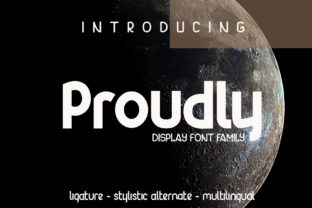
Proudly: Where Modern Typography Meets Human-Centered Design
Typography is no longer just about legibility—it’s about resonance. In a world saturated with digital interfaces, fleeting attention spans, and increasingly nuanced brand expectations, the fonts we choose carry quiet but powerful signals: about tone, intention, and values. Enter Proudly: a display font that doesn’t shout for attention but earns it—through smooth curves, balanced rhythm, and an unmistakable sense of warmth. Designed to be simple yet playful, Proudly reflects a broader shift in how professionals across creative, marketing, tech, and entrepreneurial fields are rethinking visual language—not as decoration, but as dialogue.
A Font That Feels Intentional—Not Just Installed
Proudly is a contemporary display typeface distinguished by its soft, confident curves and carefully considered proportions. Unlike many geometric sans-serifs that prioritize neutrality over nuance, Proudly embraces subtle asymmetry and organic flow—especially visible in letters like “a”, “g”, and “s”. Its lowercase forms invite readability without sacrificing personality; its uppercase characters hold presence without rigidity. It’s not built for body text at small sizes—but it thrives where voice matters most: headlines, logos, hero sections, product names, and campaign statements.
What makes Proudly stand out isn’t novelty for novelty’s sake. It’s how thoughtfully it bridges two often-opposing priorities: clarity and character. In an era where AI-generated visuals flood feeds and algorithmic design tools promise “on-brand” outputs in seconds, human-crafted details—like the gentle swell of Proudly’s “o” or the friendly tilt of its “v”—become meaningful differentiators. These aren’t flourishes; they’re cues that signal care, craft, and consistency.
Why Professionals Are Choosing Proudly—Now
The rise of Proudly mirrors deeper shifts across industries:
- From scalable to soulful branding: Startups and solopreneurs no longer default to ultra-minimalist fonts to appear “serious.” Instead, they seek type that conveys approachability *and* authority—especially when building direct-to-consumer relationships. A fintech founder using Proudly for their app’s onboarding headline communicates trust *and* ease—not cold efficiency.
- Design systems with emotional intelligence: Enterprise teams integrating Proudly into component libraries aren’t adding a “fun” option—they’re expanding expressive range. When paired with a robust, neutral sans-serif (like Inter or IBM Plex) for UI text, Proudly becomes the human voice in an otherwise functional interface—used sparingly, intentionally, and always contextually.
- Content that breathes—and converts: Marketers notice that landing pages featuring Proudly in primary headings see higher scroll depth and time-on-page metrics—not because the font is “louder,” but because its rhythm supports natural reading cadence. Its open counters and generous x-height improve scannability, while its warmth lowers perceived cognitive load.
These aren’t anecdotal preferences. They reflect documented behavioral trends: consumers increasingly associate visual warmth with authenticity, and professionals report rising fatigue with overly rigid, “corporate-default” typography. Proudly arrives at a moment when audiences reward brands that balance polish with personality—and when creators need tools that support both precision and play.
Workflow Integration: Simplicity Without Compromise
Adoption isn’t just about aesthetics—it’s about fit. Proudly was designed with modern workflows in mind. Its OpenType features include stylistic alternates, ligatures, and case-sensitive forms—accessible through standard CSS @font-face declarations or platform-native font managers. No complex setup. No licensing friction for commercial use. It works seamlessly with Figma’s variable font plugins, Webflow’s custom font uploader, and Shopify’s theme editors.
More importantly, Proudly respects constraints without demanding sacrifice. A freelance designer building a brand identity for a sustainable skincare line might use Proudly for the logo and campaign tagline (“Grown With Care”), then switch to a highly legible, accessible sans-serif for ingredient lists and regulatory text. That contrast isn’t arbitrary—it’s strategic layering: one voice for emotion, another for clarity.
Similarly, developers appreciate that Proudly ships with optimized WOFF2 files and clear fallback guidance. When paired with font-display: swap, it loads gracefully—even on slower connections—ensuring the expressive intent remains intact without compromising Core Web Vitals.
Real-World Observations: Beyond the Spec Sheet
Look closely at recent award-winning sites on Awwwards or SiteInspire, and you’ll spot Proudly in action—not as a decorative afterthought, but as a structural element of tone. A climate-tech nonprofit uses it in animated SVG headers where letterforms gently morph between states (“Act”, “Adapt”, “Advance”)—leveraging its curve-based geometry for smooth transitions. An indie publishing house deploys Proudly across book cover thumbnails in their online catalog, creating visual cohesion that feels curated, not templated.
These choices succeed because they align Proudly’s inherent qualities with functional goals: its curves support motion; its friendliness supports storytelling; its restraint supports scalability. It doesn’t try to do everything—so it does its job exceptionally well.
Context Over Consistency: The New Typography Standard
Historically, typography guidelines emphasized uniformity: one font family, strict hierarchy, minimal variation. Today’s best practices emphasize contextual appropriateness. That means selecting typefaces not based on trend cycles, but on how well they serve specific communication objectives—across devices, audiences, and moments of interaction.
Proudly fits squarely within this evolution. It’s not positioned as a “universal solution,” but as a purpose-built tool—for moments when humanity needs to be foregrounded. When a SaaS dashboard introduces a new feature with empathy (“We’ve made this easier for you”), Proudly delivers the right weight and warmth. When a creator launches a newsletter titled Small Joys, its rounded terminals and open spacing echo the theme before a single word is read.
This reflects larger technological and cultural developments: the maturation of variable fonts, the rise of inclusive design frameworks, and growing recognition that accessibility includes emotional resonance—not just color contrast or screen reader compatibility. A font that feels welcoming can lower barriers to engagement just as effectively as alt-text or keyboard navigation.
Looking Ahead: Typography as a Strategic Layer
As generative AI reshapes how content is produced—from copy to code to composition—the value of intentional, human-authored assets grows. Proudly doesn’t resist automation; it complements it. When AI drafts a campaign headline, Proudly provides the distinctive voice that prevents output from blending into the noise. When automated tools generate social thumbnails, Proudly ensures the text element carries brand-specific warmth—not generic polish.
For entrepreneurs launching MVPs, for marketers optimizing conversion paths, for designers building systems that scale—Proudly represents more than a type choice. It’s evidence of a maturing discipline: one that treats typography not as static decoration, but as dynamic, contextual, and deeply human infrastructure.
Its smooth curves aren’t just visual—they’re conceptual. They reflect a design philosophy that favors connection over correction, clarity over complexity, and confidence without compromise. In a landscape where attention is scarce and authenticity is earned, Proudly doesn’t ask to be seen. It invites you to be understood.
Whether you're refining a brand voice, shipping a product update, or simply choosing how your next project begins its story—consider what your typography says before the first sentence is read. With Proudly, the message starts with movement, continues with meaning, and lands with resonance.