Stenciland: Bold, Unmistakable, Built to Stand Out
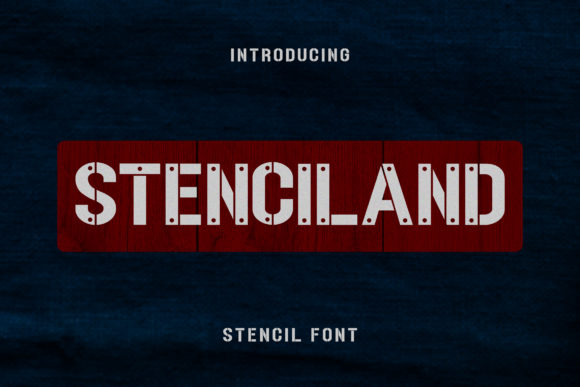
If you’ve ever needed text that doesn’t just sit on the page—but *announces itself*—you already know the power of a true display font. Stenciland isn’t subtle. It’s not meant to whisper. It’s a premium font designed with sharp, chiseled edges, strong negative space, and an unmistakable industrial confidence. Think stenciled signage on steel shipping containers, vintage military equipment labels, or hand-cut lettering on workshop walls—then refined into a precise, scalable typeface. Its personality is direct, no-nonsense, and quietly authoritative. There’s no flourish, no curve for the sake of it—just clean geometry, consistent stroke weight, and deliberate gaps that make every character pop.
Where Stenciland Earns Its Place—Not Just Its Look
Stenciland thrives where impact matters more than extended reading. It’s a display font first and foremost—not a body text workhorse. That distinction is critical. Use it for headlines, logos, posters, album covers, packaging front panels, social media banners, or event signage, and it delivers immediate visual weight. Try it on a small-batch craft beer label: the ruggedness reinforces authenticity. Drop it into a fitness brand’s Instagram carousel: it mirrors discipline and strength. Pair it with a neutral sans serif like Inter or Montserrat for editorial design—say, a magazine cover story on urban renewal—and the contrast gives both clarity and character.
It’s less effective in dense paragraphs, long-form web copy, or interfaces requiring fine-grained legibility at small sizes (think mobile app buttons or footnotes). That’s not a flaw—it’s alignment with intent. A font’s value lies in knowing *when not to use it* as much as when to. Stenciland’s strength is singular: commanding attention in controlled, intentional moments.
How It Shapes Perception—Without Saying a Word
Typography silently influences how people feel about your work—even before they read a single word. Stenciland conveys reliability, craftsmanship, and grounded energy. It doesn’t scream “trendy” or “playful.” Instead, it signals competence, durability, and intentionality. For a small business owner launching a line of handmade tools, using Stenciland in their logo subtly reinforces the idea of precision and function. For a publisher releasing a nonfiction book on infrastructure or logistics, it adds visual gravitas without leaning into cliché.
That consistency matters. When used across touchpoints—a website banner, a trade show booth, and product tags—the font becomes part of the brand identity’s texture. Not the whole story, but a memorable thread. And because it’s distinct without being eccentric, it avoids looking gimmicky or dated. It’s modern typography rooted in real-world utility—not algorithmic novelty.
Testing Fit: Practical Checks Before You Commit
Before licensing Stenciland, ask three things:
- Is this the focal point? If the text needs to be scanned quickly—like a sale tag, festival name, or podcast title—it’s likely a fit. If it’s supporting copy, step back.
- Does the context reward boldness? A minimalist café menu? Probably not. A streetwear brand’s limited-edition drop announcement? Absolutely.
- What’s the background doing? Stenciland gains power against solid colors or high-contrast imagery. Avoid busy textures or low-contrast gradients behind it—those fight its clarity.
Also check the included styles. Most Stenciland licenses include Regular and Bold weights—sometimes with all-caps variants or alternate characters. There’s no italic or condensed version, and that’s by design. Its voice doesn’t bend. If your project demands typographic flexibility (e.g., quoting text within a headline), pair it intentionally: a clean, highly readable sans serif for secondary text balances its intensity without competing.
Pairing Smartly—Not Just Matching
Good font pairing isn’t about similarity—it’s about complementary roles. Stenciland works best beside typefaces that do the opposite: quiet, even, generous in spacing and x-height. Avoid other display fonts, decorative serifs, or anything with heavy contrast or ornamentation. A humanist sans like Open Sans or a sturdy grotesque like Helvetica Now offers breathing room. In print layouts, try setting body copy in a robust serif like Merriweather—its warmth offsets Stenciland’s cool precision.
One real-world observation: designers often overcompensate by adding shadows or outlines to Stenciland. Don’t. Its power lives in its structure—not effects. Let the stencil cuts speak for themselves. If you need dimension, use color contrast instead: deep navy on cream, charcoal on pale concrete grey, or matte black on raw kraft paper.
Licensing & Real-World Use
Stenciland is a commercial font—meaning personal projects and client work both require appropriate licensing. Most foundries offer clear, tiered options: desktop use for design files, web use for live sites (with proper @font-face setup), and app or ePub embedding if needed. Always verify the license covers your intended use—especially for SaaS platforms, digital products, or merchandise you’ll sell. There’s no “free version” that’s legally safe for business use; using unlicensed fonts risks takedowns, legal notices, or brand inconsistency if you later switch.
For content creators building Canva templates, bloggers designing Pinterest pins, or crafters selling printable wall art—yes, you need a license. But it’s a one-time investment that scales: one license typically covers unlimited projects for one user, and many include updates. Think of it as buying durable design assets—not renting pixels.
Finally, test early and test physically. Render Stenciland at actual size on the devices or materials you’ll use. Print a mock-up of your packaging. View your social graphic on a phone screen in daylight. Does the letter spacing hold? Do the inner counters (like the hole in ‘A’ or ‘O’) stay open and legible? If not, adjust tracking slightly—or reconsider scale. Stenciland rewards thoughtful execution, not just bold choices.