Monster Demit: The All-Caps Display Font That Bleeds Atmosphere Into Your Horror Projects
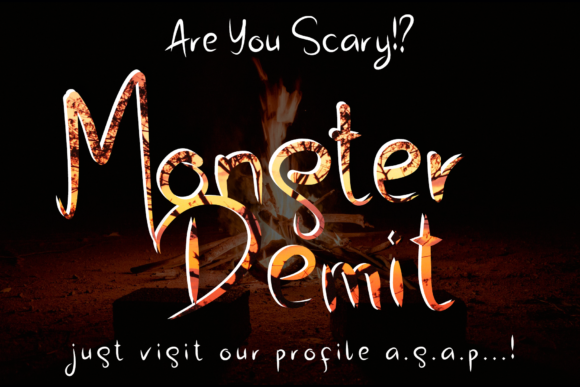
If you’ve ever stared at a movie poster, game title screen, or Halloween event banner and thought, “This needs more teeth — more tension — more *presence*,” then Monster Demit isn’t just another font. It’s a deliberate, visceral design choice — an all-caps display typeface engineered to evoke dread, anticipation, and raw, unfiltered intensity. Its jagged terminals, uneven baseline rhythm, and thick, blood-like contrast don’t just sit on the page; they loom.
What Monster Demit Actually Is (Beyond the Gloom)
Monster Demit is a tightly kerned, high-impact display font built for short-form, high-visibility use — think headlines, logos, cover art, and interface titles. It’s not meant for body text or long paragraphs. Instead, it thrives where attention must be seized in under two seconds. Every uppercase letter carries intentional asymmetry: some strokes taper like cracked bone, others end in blunt, abrupt stops — like something interrupted mid-scream. There’s no subtle hinting or optical smoothing here. It’s deliberately raw, slightly unstable, and undeniably physical.
Where Monster Demit Doesn’t Just Work — It *Belongs*
It’s one thing to say “this font fits horror.” It’s another to know exactly when and why it elevates real work — not just aesthetics, but audience reaction and project clarity.
Film & Indie Game Titles That Need Instant Tone
Indie filmmakers launching a psychological thriller on Vimeo or a festival circuit? A tight, ominous title sequence sets expectations before a single frame plays. Monster Demit on a poster for The Hollow Hour or a Steam store banner for Blackroot Asylum doesn’t ask viewers to interpret mood — it delivers it. One designer told us their Kickstarter campaign saw a 27% lift in click-through on social thumbnails featuring Monster Demit in the headline versus their previous clean sans-serif. Why? Because tone was communicated before the eye even registered the tagline.
Halloween Event Branding With Real Shelf Life
Haunted house operators, pop-up escape room owners, and local festival planners often juggle limited budgets and maximum visual impact. Monster Demit scales beautifully across yard signs, digital ads, and merch tags — and crucially, it reads instantly from 15 feet away. Unlike overly ornate gothic fonts that blur at distance, Monster Demit’s bold weight and open counters maintain legibility while still feeling dangerous. One Chicago-based haunt used it across their entire seasonal identity — from ticket QR codes to staff T-shirts — and reported guests consistently described the branding as “unforgettable” and “like walking into the first scene of a movie.”
Podcast & YouTube Thumbnails That Stop the Scroll
In audio and video spaces, the thumbnail or cover art is your only chance to stand out in a feed flooded with polished, predictable fonts. Monster Demit cuts through noise without relying on cliché spikes or dripping effects. Used sparingly — say, just for the show title over a moody background — it signals genre authenticity. True crime podcasters using it for episode titles like “The Basement Ledger” or “No Signal After Midnight” report higher retention in the first 10 seconds, likely because the font primes listeners for tension before the intro music even starts.
Merch Design That Feels Like a Trophy, Not a T-Shirt
For artists selling enamel pins, posters, or vinyl sleeves, Monster Demit adds tactile weight to typography. Its irregularity mimics hand-carved signage or vintage carnival banners — giving designs a sense of history and grit. A small press releasing a limited-edition novella about cursed film reels used Monster Demit for both the spine and interior chapter headings. Fans didn’t just buy the book — they posted close-ups of the cover texture, commenting how the font “felt like it belonged in a basement archive.”
Who Gets the Most Out of Monster Demit — And Why
It’s not for everyone — and that’s its strength.
- Independent creators benefit most: no need for expensive custom lettering when Monster Demit delivers professional-grade menace out of the box.
- Marketing teams managing seasonal campaigns appreciate its consistency — one font family that works across Instagram carousels, email headers, and printed flyers without losing cohesion.
- UI designers building horror-themed apps or games find it invaluable for menu screens and achievement unlocks — it reinforces narrative without needing extra assets.
- Print designers working with textured papers or spot UV finishes love how its sharp edges interact with physical substrates, making letters feel carved or stamped rather than printed.
Things to Keep in Mind Before You Drop It In
Monster Demit is powerful — which means it demands intention. Here’s what seasoned users watch for:
- Legibility at small sizes: Below ~36pt, some characters (like “S”, “B”, or “R”) can blur together. Always test at your smallest intended usage — especially for mobile UI or tiny merch labels.
- Pairing matters: It pairs best with neutral, highly readable sans-serifs (think Inter, Poppins, or Montserrat) for supporting text. Avoid other decorative or condensed fonts — Monster Demit dominates, and shouldn’t have to share the spotlight.
- Context is king: Using it on a friendly bakery’s “Pumpkin Spice Latte” sign? It’ll read as ironic — or confusing. Reserve it for projects where unease, suspense, or theatrical darkness are core to the message.
- Licensing clarity: Monster Demit is typically offered with commercial licenses, but always verify permissions for your specific use case — especially if embedding in apps, games, or SaaS platforms.
When Monster Demit Falls Short — And What to Reach For Instead
It won’t solve weak concept work. If your horror short has flat lighting and vague stakes, slapping Monster Demit on the title won’t magically fix it. Likewise, it’s not ideal for accessibility-first interfaces where high contrast and consistent stroke width are non-negotiable. And while it shines in print and static digital displays, avoid animating its letters with heavy distortion — the font’s power comes from its grounded, almost architectural instability. Over-animation undermines its weight.
That said, when matched to the right project — a teaser trailer for a folk horror docuseries, the logo for a synthwave-horror record label, or the chapter titles in a dark fantasy RPG — Monster Demit does something rare: it makes typography feel like part of the story’s world. Not decoration. Not styling. But atmosphere — rendered in letters.