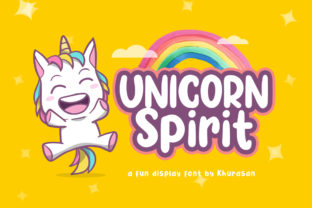
Unicorn Spirit: A Happy Display Font for Playful, Expressive Design
Unicorn Spirit is a display font designed to evoke joy, whimsy, and gentle charm. It’s not built for body text or long-form reading — instead, it thrives where personality matters most: headlines, logos, invitations, social media graphics, and short promotional phrases. Its rounded, slightly bouncy letterforms, soft curves, and subtle asymmetry give it a hand-drawn warmth without sacrificing clarity or typographic intentionality. Unlike many decorative fonts that prioritize novelty over usability, Unicorn Spirit balances expressiveness with functional legibility at medium to large sizes.
What Makes Unicorn Spirit Distinct in the Display Font Landscape
Many display fonts fall into predictable categories: ultra-thin script, bold geometric sans, or highly ornate serif. Unicorn Spirit occupies a quieter but increasingly relevant niche — the happy display font. This isn’t just about adding a smiley face or rainbow gradient; it’s about embedding positivity into structure. The lowercase “a” and “g” use single-story forms that feel approachable. The “o” and “e” are gently oval rather than perfectly circular, avoiding mechanical rigidity. Letter spacing is open but intentional, supporting rhythm without drifting into looseness. Even punctuation — like the upward tilt of the exclamation mark — reinforces its light-hearted tone.
This consistency of mood sets Unicorn Spirit apart from fonts that rely on contrast (e.g., mixing sharp angles with soft curves) or irony (e.g., a “fun” font with aggressive stroke endings). It doesn’t try to be ironic, nostalgic, or minimalist. It simply commits to warmth — making it especially effective when authenticity and emotional resonance matter more than trend-chasing.
Fitness for Purpose: Where Unicorn Spirit Shines
Unicorn Spirit works best when the goal is to signal friendliness, inclusivity, or gentle celebration. Consider these realistic applications:
- A children’s book illustrator using it for chapter titles — where readability and tone must align for young readers and their caregivers.
- A wellness brand launching a new line of herbal teas, choosing Unicorn Spirit for packaging headers to reinforce calm, natural energy without clinical sterility.
- An independent bakery naming a seasonal cupcake (“Stardust Sprinkle”) — the font adds narrative texture without overwhelming the product photo.
- A nonprofit organizing a community art day opting for Unicorn Spirit in event posters — it feels welcoming to all ages and backgrounds, unlike fonts that skew overly youthful or corporate.
In each case, the choice supports communication goals: reducing perceived distance between creator and audience, softening messaging without diluting meaning, and reinforcing brand voice through typography alone.
Tradeoffs and Practical Considerations
No display font is universally appropriate — and Unicorn Spirit’s strengths come with clear boundaries. Its primary limitation is scale sensitivity. Below ~36pt, details like the delicate terminals on “r” or “c” begin to blur, and counters (the enclosed spaces in “o”, “e”, “a”) can fill in on lower-resolution screens or print. It’s not suitable for captions, UI buttons, or responsive web navigation — those demand functional clarity above all.
Another consideration is tonal alignment. Because Unicorn Spirit carries such a distinct emotional signature, it risks clashing with serious, technical, or authoritative contexts. Using it for a financial services report, legal disclaimer, or medical information banner would undermine credibility — not because the font is “bad,” but because typography contributes meaning. Readers subconsciously match typeface tone to content intent; mismatch creates friction.
Also worth noting: Unicorn Spirit is a single-weight, single-style family. It does not include italics, bold variants, or condensed versions. That simplifies pairing decisions (no need to hunt for compatible weights), but limits flexibility in hierarchical layouts where visual contrast between heading levels relies on weight shifts. Designers who routinely build multi-tiered typographic systems may need to pair it thoughtfully with a neutral, highly legible sans-serif for subheads or body copy.
How It Compares With Other Approaches to Expressive Typography
When evaluating expressive display fonts, designers often weigh three broad strategies: hand-lettered authenticity, stylized simplicity, and playful illustration. Unicorn Spirit sits closest to the first — but with refinement. Hand-lettered fonts sometimes sacrifice consistency across characters or struggle with kerning; Unicorn Spirit maintains even rhythm and balanced spacing while preserving organic feel.
Compared to stylized simplicity (think clean, friendly sans-serifs with subtle rounded corners), Unicorn Spirit offers more character — but less neutrality. A rounded sans might work equally well for a tech startup and a preschool newsletter; Unicorn Spirit leans decisively toward the latter. That’s not a weakness — it’s specificity. Knowing when to choose specificity over flexibility is part of professional judgment.
Against illustrative or pictorial fonts (where letters incorporate icons, textures, or thematic motifs), Unicorn Spirit avoids visual clutter. It doesn’t require decoding — its charm emerges from form, not decoration. That makes it more versatile across mediums and more accessible to readers who benefit from clear, unambiguous shapes (including some neurodivergent users).
Making the Choice: When Unicorn Spirit Fits — and When It Doesn’t
Ask yourself these questions before selecting Unicorn Spirit:
- Is the message emotionally warm, inclusive, or lighthearted? If yes, it’s a strong candidate. If the tone needs gravitas, urgency, or precision, look elsewhere.
- Will it appear at sizes where its details remain legible? Test it at your smallest intended use — on mobile, in print, or in projected presentations.
- Does your design system already include a robust, neutral companion font? Unicorn Spirit pairs best with understated sans-serifs (like Inter, Lato, or Manrope) or gentle serifs (such as Cormorant Garamond or Zilla Slab). Avoid pairing it with other high-personality fonts — the result can feel chaotic rather than cohesive.
- Are you prioritizing quick recognition over stylistic experimentation? Unicorn Spirit is distinctive but not obscure. Readers grasp its intent immediately — which supports comprehension, especially in time-constrained environments like social feeds or event signage.
If your project involves multilingual support beyond basic Latin characters, verify whether Unicorn Spirit includes extended language coverage (e.g., accented characters for French, Spanish, or Polish). Some display fonts stop at the core 26 letters — limiting usability in global or diverse-language contexts.
Real-World Pairing Examples
Designers using Unicorn Spirit often combine it with complementary fonts to create balance. For example:
- A wedding invitation suite might use Unicorn Spirit for the couple’s names and “Join Us” headline, paired with a delicate serif (like Playfair Display) for date and location — letting the display font carry emotion while the serif handles formal information with quiet elegance.
- An educational app for early literacy could feature Unicorn Spirit in animated “letter of the day” banners, backed by a highly legible, dyslexia-friendly sans-serif (like Open Dyslexic or Lexend) for instructions and definitions — separating expressive hooks from functional text.
- A small-batch candle brand might apply Unicorn Spirit to scent names (“Midnight Meadow”, “Honey & Hearth”) on labels, while using a clean, low-contrast sans-serif (like Poppins Light) for ingredients and safety text — ensuring regulatory compliance doesn’t compete with brand voice.
In each case, Unicorn Spirit isn’t carrying the full communicative load. It’s doing one thing exceptionally well: inviting attention with kindness. That focused utility is why it endures among professionals who value intention over ornamentation.